
Filing bankruptcy in San Diego, one question is probably eating at you above everything else: Will I lose my house?
That fear makes complete sense. Your home isn’t just square footage; it’s your kids’ school district, your routine, your stability. The short answer is: most San Diego homeowners who file bankruptcy do keep their homes. But “most” depends on a few specific things, like how much equity you have, whether you’re current on your mortgage, and which type of bankruptcy you file. Let’s walk through all of it, plainly.
What Happens to Your Home When You File Bankruptcy
Here’s the thing nobody really tells you before you file: bankruptcy doesn’t automatically mean you lose your house. It’s not a liquidation sale on your life. The outcome for your home depends entirely on the details of your situation.
And those details start with what happens the second you file.
The Automatic Stay, Your Immediate Legal Shield
The moment your bankruptcy petition hits the court, something called the automatic stay goes into effect. Think of it as a legal freeze button. Every collection call stops. Every creditor letter stops. And, this is the big one: any active foreclosure on your home stops, too.
It doesn’t matter if your lender was three weeks from auction. Filing bankruptcy puts the brakes on all of it, immediately.
Now, the automatic stay isn’t permanent. It’s breathing room, not a permanent fix. But sometimes breathing room is exactly what you need to get your bearings, work with an attorney, and actually build a real strategy for your home.
The Role of Your Home Equity
This is where it gets a bit technical, but it’s worth understanding because it drives almost every decision in your case.
Home equity is simply what your house is worth minus what you still owe on it. If your San Diego home is worth $750,000 and you owe $600,000, your equity is $150,000.
In California bankruptcy, that equity is protected up to a certain dollar amount, called the homestead exemption. And California’s homestead exemption is, honestly, one of the most generous in the country right now.
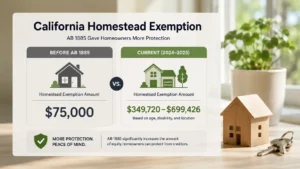
Before 2021, the exemption for a single homeowner was just $75,000. That’s it. San Diego home values had already blown past that years ago, which left a lot of homeowners exposed. Then Assembly Bill 1885 (AB 1885) changed everything. The minimum homestead exemption in California is now $300,000, and the maximum is $600,000, adjusted annually on January 1st, based on the median sale price of single-family homes in each county for the prior year. As of 2024, the exemption ranged from a minimum of $349,720 to a maximum of $699,426, depending on county median home sale prices.
San Diego’s home values mean most homeowners here fall toward the higher end of that range.
What this means practically: if your home equity is within that protected range, the bankruptcy trustee cannot force you to sell your home to pay off unsecured creditors. Your equity is shielded by law. That’s a massive change from even five years ago.
Chapter 7 vs. Chapter 13, Which One Lets You Keep Your House?
This is the core of the whole question. The answer is completely different depending on which chapter you file, and getting this wrong can cost you the home you were trying to protect.
Chapter 7: Clean Slate, But With Real Conditions
Chapter 7 is what most people picture when they hear “bankruptcy”: wipe out the debt, get your discharge, and move on. The whole process usually wraps up in three to six months. And yes, you can absolutely keep your home in Chapter 7.
But two conditions have to be true:
First, you need to be current on your mortgage. Chapter 7 doesn’t fix missed payments. It wipes out unsecured debt like credit cards, medical bills, and personal loans — but your mortgage is a secured debt tied directly to your home. If you’re behind, the automatic stay delays foreclosure, but once your bankruptcy case closes, the lender picks right back up where they left off. So if you want to keep the house through Chapter 7, you need to be up to date on payments.
Second, your equity needs to fall within the homestead exemption. Let’s say you have $250,000 in equity on your San Diego home. That’s well within the protected range. The trustee has no financial reason to touch it, there’s nothing to sell that would benefit creditors. You keep the house, you keep paying your mortgage, done.
But here’s the scenario that actually catches people off guard in San Diego: what if your equity has grown significantly? San Diego home values have appreciated dramatically over the last decade. If your equity is, say, $800,000 and your exemption only covers $650,000, that remaining $150,000 is exposed. A trustee could potentially force a sale, pay creditors from the surplus, and return your protected amount to you. That’s not hypothetical; it happens.
One more thing that confuses people: in Chapter 7, you don’t necessarily need to sign a new contract with your lender (called a reaffirmation agreement) to stay in your home. You indicate your intent to keep the property in your bankruptcy petition, and you keep making payments. Some lenders request a reaffirmation agreement anyway. Whether to sign one is a conversation worth having with your attorney, because signing it makes you personally liable on the mortgage again, even after discharge.
Chapter 13: The Right Tool When You’re Behind on Payments
If you’ve missed mortgage payments and foreclosure feels real and close, Chapter 13 might be the most powerful financial tool available to you right now.
Here’s why. Chapter 13 is a reorganization; instead of wiping out debt immediately, you pay back what you can afford over three to five years through a court-approved plan. And within that plan, you can include your missed mortgage payments, called arrears, and catch them up gradually over the life of the plan.
Think about what that actually means. You’re four months behind. That’s maybe $8,000 to $12,000 in missed payments, depending on your loan. In Chapter 13, you spread that entire amount over 36 to 60 months while also continuing your regular monthly mortgage payments going forward. Your lender cannot foreclose as long as you’re current on your plan.
If you’re willing to repay your missed mortgage payments and can propose a viable Chapter 13 repayment plan that’s accepted by the court, Chapter 13 can permanently stop foreclosure of your home. Not just delay it, but permanently stop it, as long as you complete the plan.
That’s a real lifeline. And it’s something Chapter 7 simply cannot offer.
The tradeoff is real, though. You’re committing to years of structured, court-supervised payments. You need a regular income to fund the plan; no income means no plan, and no plan means no Chapter 13. And it’s a longer, more demanding process than Chapter 7.
But for homeowners who are behind on payments and want to keep their house? It’s often the only path that actually works.

What If You Don’t Want to Keep the House In Sandiego?
This doesn’t come up much in competitor content, but it’s worth addressing: what if you’re underwater on your mortgage, you’re exhausted, and honestly, you just want out?
Bankruptcy can help with that, too. You can surrender the property in your bankruptcy and walk away from the mortgage debt. In Chapter 7, once the home is surrendered, the remaining mortgage balance is typically discharged, meaning you don’t owe it. That’s a clean exit from a financial burden that was dragging you down. You don’t have to fight to keep a home that no longer makes sense for you.
3 Questions That Determine Your Path In Bankruptcy
Every bankruptcy case is specific to the person filing. But when it comes to your home, these three questions shape almost everything:
- How much equity do you have? Get a realistic sense of your home’s current value and subtract what you owe. Compare that to the current California homestead exemption for San Diego. This tells you your risk exposure.
- Are you current on your mortgage or behind? Current payments generally point toward Chapter 7 being a viable option. Being behind on payments almost always points toward Chapter 13 if keeping the house is the goal.
- Do you have a regular income? Chapter 13 requires a steady income to fund the repayment plan. Without it, Chapter 13 isn’t available to you, which circles back to whether your equity situation makes Chapter 7 safe.
The combinations of these three factors are what your attorney will be analyzing before recommending anything. Don’t try to self-diagnose this one. The cost of getting it wrong is your home.
Choosing The Right Chapter Is The Real Win
Most San Diego homeowners who file bankruptcy don’t lose their homes. California’s homestead exemption is genuinely strong, and after AB 1885, it protects more equity than almost anywhere else in the country. Both Chapter 7 and Chapter 13 offer real paths to keeping your house, just through different mechanisms.
But the wrong chapter, filed at the wrong time, without understanding your equity exposure, can cost you what you were trying to protect. The details matter. The timing matters.
If foreclosure is already on the table, don’t wait to understand your options. The automatic stay can stop it, but only if you file before it finalizes. Talk to a San Diego bankruptcy attorney today, your first consultation is free.