
Look, if you’re reading this, I’m guessing you’ve spent a few nights staring at the ceiling, doing math in your head. You’re wondering if you’re “broke enough” to get help, or if there’s some magic number you have to hit before a judge will take you seriously. Maybe you’ve been Googling bankruptcy at midnight, then closing the tab before anyone can see.
Asking the question is the right move. The people who stay buried aren’t the ones who couldn’t afford a way out; they’re often the ones who waited too long because they didn’t think they qualified, or thought it would get better on its own, or were too ashamed to pick up the phone.
I’ve seen this pattern a thousand times. People wait and wait, hoping things will click into place, while interest compounds and collection calls stack up. You convince yourself it’s not bad enough yet. Then six months later, it’s worse.
The debt that felt manageable at $12,000 is now $16,000 because you’ve been making minimum payments on a 29% APR card, and the math simply doesn’t work in your favor. And then you feel even more stuck.
So here’s the first thing you should know: there is no minimum debt law in California. But there is a point where filing for bankruptcy actually makes financial sense for your wallet and for your peace of mind. Let’s break down exactly how to find that point in 2026.
Is There a Minimum Debt to File Bankruptcy in California?
Federal bankruptcy law, which California follows, sets no floor. You could technically file for bankruptcy over $500. But any honest attorney in San Diego or anywhere else in California will tell you that doing so would be a financial mistake. The costs of filing in dollars, time, and long-term credit impact would far outweigh the relief.
The courts don’t run a competition where the biggest debt wins. What they actually care about is something called insolvency, and that’s a far more useful question than “how much do I owe?”
Insolvency just means your bills are bigger than your paycheck and your assets. If you can’t meet your financial obligations as they come due, even if you wanted to, you are technically a candidate for relief, regardless of the total figure on paper.
Why Total Debt Amount Doesn’t Tell the Full Story
For example: A person drowning in $13,000 of high-interest credit card debt on a modest income may be in a far worse position than someone carrying $45,000 in manageable installment loans with a stable job and a realistic repayment timeline. The absolute number is almost beside the point. What matters is whether you have any realistic path out.
What Types of Debt Can Be Discharged in Bankruptcy?
The types of debt that can be wiped out in bankruptcy… what the law calls “dischargeable” debts, typically include credit card balances, medical bills, personal loans, payday loans, utility arrears, certain personal judgments, and some older tax debts. Secured debts like your mortgage or car loan work differently. Bankruptcy can help you restructure those, but you generally can’t discharge a secured debt and simply keep the asset attached to it.
That’s a nuance worth understanding before you sit down with anyone, because it shapes which type of bankruptcy makes sense for your situation.
What Is the Practical Minimum Debt to File Bankruptcy in California?
Most experienced California bankruptcy attorneys will tell you that the range where filing actually makes financial sense lies somewhere between $10,000 and $15,000 in unsecured debt. Not because any rule says so, but because of simple arithmetic.
Bankruptcy is not free, and that surprises many people who assume the government just steps in and resets the clock. Before you can even discuss relief, you need to understand what you’re spending to get there.
Why Filing Bankruptcy Isn’t Free (Real Costs Explained)
Court filing fees in 2026 run approximately $338 for Chapter 7 or $313 for Chapter 13. On top of that, federal law requires you to complete a credit counseling course before filing and a financial management course before your debts are discharged, typically $25 to $50 each, though fee waivers exist for qualifying low-income filers.
How Much Does It Cost to File Bankruptcy in California?
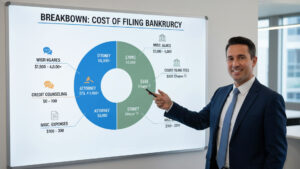
The high cost, though, is attorney fees. In California, a standard Chapter 7 case runs anywhere from $1,500 to $2,500. Chapter 13 is considerably more involved. Because your attorney has to prepare, file, and manage a multi-year repayment plan and fees there typically range from $3,000 to $4,500.
Some people attempt to file without an attorney, which is called “pro se” filing, but the petition is long and detailed, the exemptions are easy to misapply, and mistakes can cost you assets or result in dismissal. It is rarely worth the risk. So, don’t risk your assets on a paperwork error. And make sure your filing is handled by a local attorney correctly the first time.
When Bankruptcy Actually Makes Financial Sense
Here’s the math that clarifies everything: if you owe $3,000 in credit card debt but it will cost $2,000 in fees to file, you have essentially traded one debt for another and added a seven-to-ten-year mark on your credit report in the process. There are far less damaging ways to handle $3,000.
Flip that scenario to $25,000 in debt with a 24% average interest rate and minimum monthly payments that barely touch the principal, and the calculation looks completely different. The filing cost becomes a fraction of what you’d pay in interest alone over the next three years, never mind what it costs you in sleep and stress.
How Bankruptcy Affects Your Credit Score
A Chapter 7 bankruptcy stays on your credit report for ten years. Chapter 13 lingers for seven. Those aren’t trivial numbers; they affect your ability to rent an apartment, qualify for a car loan, apply for a mortgage, and, in some fields, pass an employment background check.
Can You Rebuild Your Credit After Bankruptcy?
But if you are already 90 days past due on multiple accounts, your credit score is already in serious trouble. Bankruptcy doesn’t take you from excellent to terrible. For many filers, it moves them from already-damaged to a clean starting point they can actually rebuild from. The path back from bankruptcy is real. With disciplined use of a secured credit card and consistent, on-time bill payment, many people see their scores climb back into the 680s and 700s within three to four years of filing. Plenty of former filers are buying homes again, well before the bankruptcy falls off their report entirely.
Bankruptcy Eligibility in California: Chapter 7 vs Chapter 13
Qualifying for bankruptcy is not automatic. California follows federal eligibility rules, and depending on your income and goals, you’ll land in one of two main chapters. For a precise eligibility check, you can visit us at our San Diego office or our El Centro location to have an attorney review your specific financial documents.
Chapter 7 Bankruptcy Income Limits (Means Test Explained)
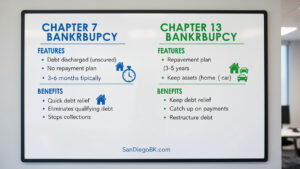
Chapter 7 is the version where eligible debts are discharged relatively quickly, usually within three to six months, with no long repayment plan attached. To qualify, your income generally needs to fall below California’s median for your household size. As of 2026, those thresholds look approximately like this:
| Household Size | Estimated Median Income |
| 1 Person | ~$77,221 |
| 2 People | ~$100,161 |
| 3 People | ~$113,553 |
| 4 People | ~$135,505 |
If your income exceeds the median, you don’t automatically get disqualified. You’ll need to pass a more detailed calculation, the full means test that weighs your allowable living expenses against your disposable income. An experienced attorney can run that analysis in a single consultation. In many cases, people who initially assume they earn “too much” turn out to qualify after allowable expenses are factored in.
Chapter 13 Bankruptcy: How It Works and Who It’s For
If Chapter 7 isn’t available or isn’t the right fit, say, you have significant home equity you want to protect, or you’ve fallen behind on a mortgage and want to stop a foreclosure, Chapter 13 works differently.
Rather than wiping debts out immediately, you propose a three-to-five-year repayment plan and pay back a portion of what you owe based on your disposable income. For cases filed between 2025 and 2028, you need to be under $526,700 in unsecured debt and $1,580,125 in secured debt, limits that most consumer filers won’t come close to.
Key Benefits of Chapter 13 Bankruptcy
Chapter 13 has real advantages that get overlooked in the conversation. It can halt a foreclosure and give you time to catch up on missed mortgage payments. It can eliminate a second mortgage through a process called “lien stripping” if your home’s current value has dropped below what you owe on your first mortgage. It also allows you to repay certain non-dischargeable debts, like back taxes, at zero interest over the plan period. For the right situation, it’s a genuinely powerful restructuring tool, not just a consolation prize for people who don’t qualify for Chapter 7.
Alternatives to Bankruptcy for Lower Debt Amounts
If you’re sitting at $6,000 or $8,000, bankruptcy probably isn’t your best first move, and that’s actually good news, because you have options that won’t follow you for a decade.
Debt settlement lets you negotiate a lump-sum payoff with creditors for less than the full balance. It does hurt your credit, but less severely and for a shorter time than bankruptcy. The catch is you usually need some cash available to make a credible offer, and any forgiven balance over $600 may count as taxable income, so plan accordingly.
A Debt Management Plan through a nonprofit credit counseling agency is another strong option. The agency works with your creditors to reduce your interest rates and consolidate your payments into a single monthly amount. You pay the full balance, just at a significantly lower rate, and your credit takes minimal damage. For people with a steady income who are burdened by high interest rather than catastrophic loss of earnings, this is often the smartest starting point.
Direct negotiation with creditors is also underused. Many lenders, especially medical providers and credit card companies, have hardship programs they don’t advertise. A documented hardship, job loss, divorce, or medical crisis can sometimes get you temporary payment reductions, waived fees, or interest suspensions without touching your credit score at all.
Should You File Bankruptcy in California? Final Decision…
At the end of the day, bankruptcy is not a dollar amount. It’s a decision about what your next five years look like versus the next thirty. If you’re carrying $15,000, $20,000, or more in debt with no realistic exit in sight, filing may be the most financially sound decision you can make. It is not a failure. It is a legal remedy that exists precisely because financial hardship is a human reality, not a moral failing.
That said, every situation has its own shape. Your income, your assets, credit cards, the types of debt you carry, your household size, your long-term goals, all of these factors in. Two people with identical balances can have completely different right answers.
Don’t guess with your financial future. The smartest move you can make right now is sitting down with an experienced California bankruptcy attorney from Bankruptcy Law Offices of Mark L. Miller, who can look at your actual numbers, not generic ones from a blog, but yours. Get free initial consultations, and within an hour, you’ll know whether bankruptcy is the right move or whether there’s a better path forward. Either way, you’ll have clarity instead of ceiling math.